
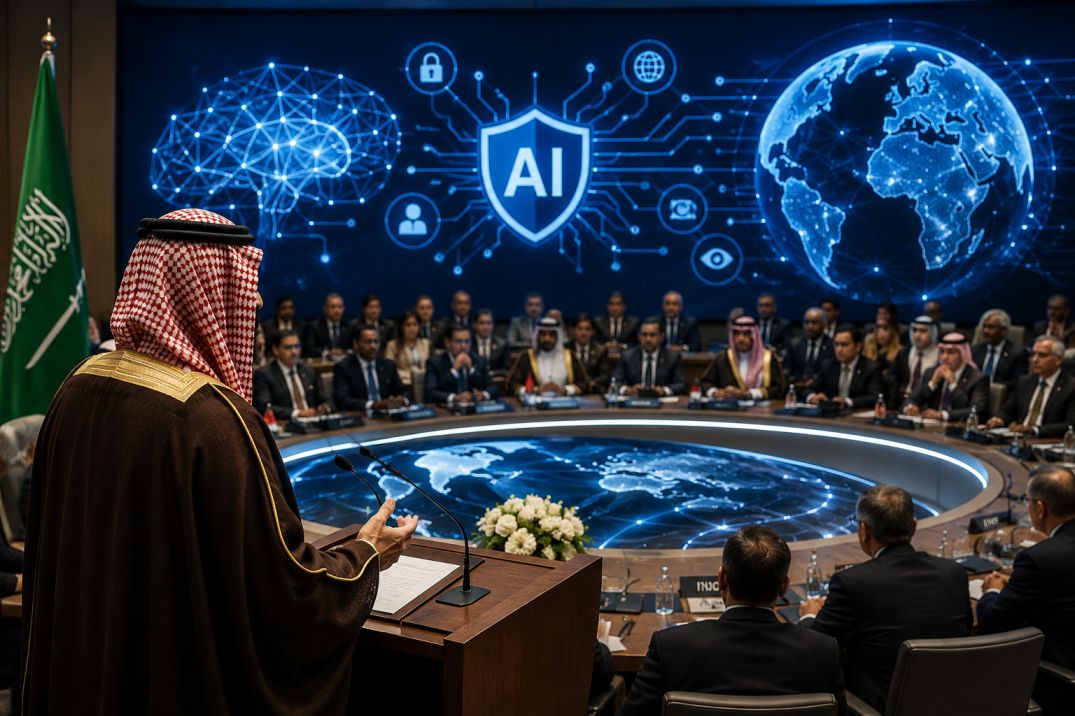
Saudi Arabia is urging increased international collaboration to prevent terrorist groups from leveraging artificial intelligence and other cutting-edge technologies. During a United Nations General Assembly session focused on strategic capacity building, Abdulaziz Alwasil, Saudi Arabia’s Permanent Representative to the UN, highlighted the urgency of countries uniting to share knowledge, bolster national defenses, and invest in sustainable capacity-building initiatives to counter emerging security threats.
Alwasil cautioned that technological advancements have provided extremist factions with new avenues to recruit supporters, disseminate propaganda, secure funding, and orchestrate attacks. He pointed out Yemen as a region of particular concern, noting that terrorist organizations, including the Houthi militia and Al-Qaeda, are attempting to harness technologies such as drones and other sophisticated systems. Alwasil stressed the necessity for governments to enhance their readiness to match the increasingly advanced tactics employed by terrorist networks.
Emphasizing that effective counterterrorism strategies surpass mere military and security operations, the Saudi envoy advocated for the development of robust institutions, modern legal frameworks, international cooperation, and ongoing investment in human and technical expertise as critical components in combating terrorism and violent extremism. He also suggested that capacity-building measures should be customized to suit the unique needs and priorities of individual countries and implemented in close collaboration with their governments to ensure enduring outcomes.
Citing Saudi Arabia’s contributions to global counterterrorism efforts, Alwasil mentioned the Kingdom’s pivotal role in founding the United Nations Counter-Terrorism Centre in 2011, along with its $110 million contribution to assist member states in executing the UN Global Counter-Terrorism Strategy. He also noted Saudi Arabia’s active involvement in initiatives like the Global Counterterrorism Forum, the Global Coalition to Defeat Daesh, and the Islamic Military Counter Terrorism Coalition. Furthermore, the Kingdom established the Global Center for Combating Extremist Ideology, known as Etidal, which employs advanced technology to track extremist content, counter online propaganda, and raise public awareness.
Alwasil also highlighted Saudi Arabia’s ongoing support for Yemen’s internationally recognized government, emphasizing the Kingdom’s efforts to enhance the country’s security institutions in partnership with local authorities. These endeavors, he explained, have strengthened the capacity to detect and dismantle financial and logistical networks aiding terrorist organizations while preventing the transfer of advanced technology and military capabilities to extremist groups. According to Alwasil, such efforts have bolstered security and stability by reducing the potential for terrorist groups to exploit instability and expand their operations.